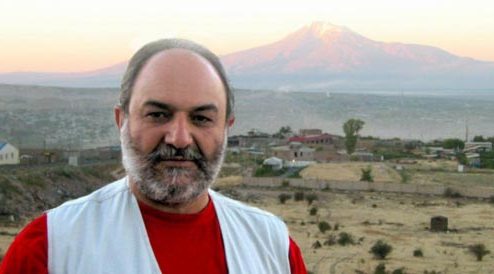
Interview with the Creator of the Sevan Music Festival Logo – Ashot Hambardzumyan
— How did you choose the path of becoming an artist?
My mother played a major role in this, and I must say that I started drawing from my school years. I used to attend an art group, and then my interest grew deeper. It turned out that… Even though I graduated from school with honors and had great progress in all subjects, which was quite surprising for my teachers, because one of them wanted me to become a physicist, another thought I should become a mathematician, and another believed I would be a great historian, I still chose to pursue painting. As strange as it sounds, I went to Terlemezian’s art school with an honors certificate, where I received a wonderful education. Later, I entered the Fine Arts and Theatre Institute (which was called the Fine Arts and Theatre Institute at the time, but is now an academy).
— What does painting mean to you?
It’s a very complicated question. It’s probably everything. When I’m happy, I paint; when I’m sad, I paint; when I’m angry, I paint; when I’m in love, I paint. Everything.
— Throughout your professional journey, has there been any individual or event that inspired you?
To be honest, it’s not just one person. There are many, regardless of the era the artist lived in. I also place great importance on my childhood meeting with Yengibaryan, and later, meeting Parajanov in my adulthood, as well as working with Henrik Maylian and Mher Mkrtchyan, with whom I had the honor of working in the theater as a set designer. You know, the enthusiasm of an individual forms over time. There are also people who have inspired me, but they are not artists; they are noble, very kind people who live through their work. I am one of those lucky artists who had the opportunity to interact with the best artists of the older generation. I have had communication with Arno Babajyan, and my internship at the Great Theatre during my sixth year at the institute was also very important. As a result, you must also be prepared for all these encounters. You know, when you are prepared, people come along who further increase your love for art, and you are able to understand their example. It’s very possible to meet genius and talented people, but if you are not ready, no contact will have an impact on you.
— Mr. Hambardzumyan, in your works, there are symbols that you often use, sometimes without even realizing it. Do you have a symbol that you love to portray in different works?
You know, it’s not about loving or portraying symbols. I also work with symbols and coats of arms. Besides, as an Armenian, there is one symbol for me: Mount Ararat. Soon, I will present a major project, and it’s no coincidence that for several years, I have been wishing the Armenian people good morning with various pictures of Ararat on social media. For the Armenian people and for me, Ararat is an important symbol. It has a very powerful energy and can be a symbol for all Armenians. When you say Armenia, we first think of Ararat. I must say that the wonderful, magnificent land where we live, called Armenia, saddens me because today we live only on ten percent of it, but I believe the day will come when we will fully live on the historical territory of Armenia. All the recent events are speaking about this.
— Mr. Hambardzumyan, could you talk about the logo of the Sevan Music Festival, which you created? How did the idea come about, and why should the logo be this way?
It was my student, Hemenen Andrikyan, who suggested the idea to me. She is a wonderful personality, very established, and a very good person. I place a lot of importance on the work of the youth in our regions because I believe there is a lack of attention to the regions in our country’s politics. Everyone is focused on the city. Besides, I welcome any such event, because today it’s very important to pay more attention to the regions, especially since communication today works very well — roads and the internet. I think it doesn’t matter much where you live, in fact, there’s an advantage because the youth in the regions are free from the noise of the city and the distractions of busy life. There is a beautiful environment that can be dedicated to creativity, to making things beautiful. I’m very happy that cultural life is starting to revive in Sevan. I must say that I did this with great love. Of course, the proposal was very honorable for me because I don’t care where it’s for, but what matters is how it should be done. If an international organization that organizes a music festival had asked me to do it, I would have approached it with the same enthusiasm as I did for the Sevan Music Festival. The symbol here is mostly a musical note, and two fish that form the letter “S” with their swirl and movement. The main idea is this. I think it’s very interestingly solved from a heraldic perspective. Recently, when I was flipping through my past works, I saw it with new eyes.
I hope such events will always be numerous because I understand the titanic effort the organizers put into organizing and implementing everything.
Prepared by: Ophelia Sargsyan
